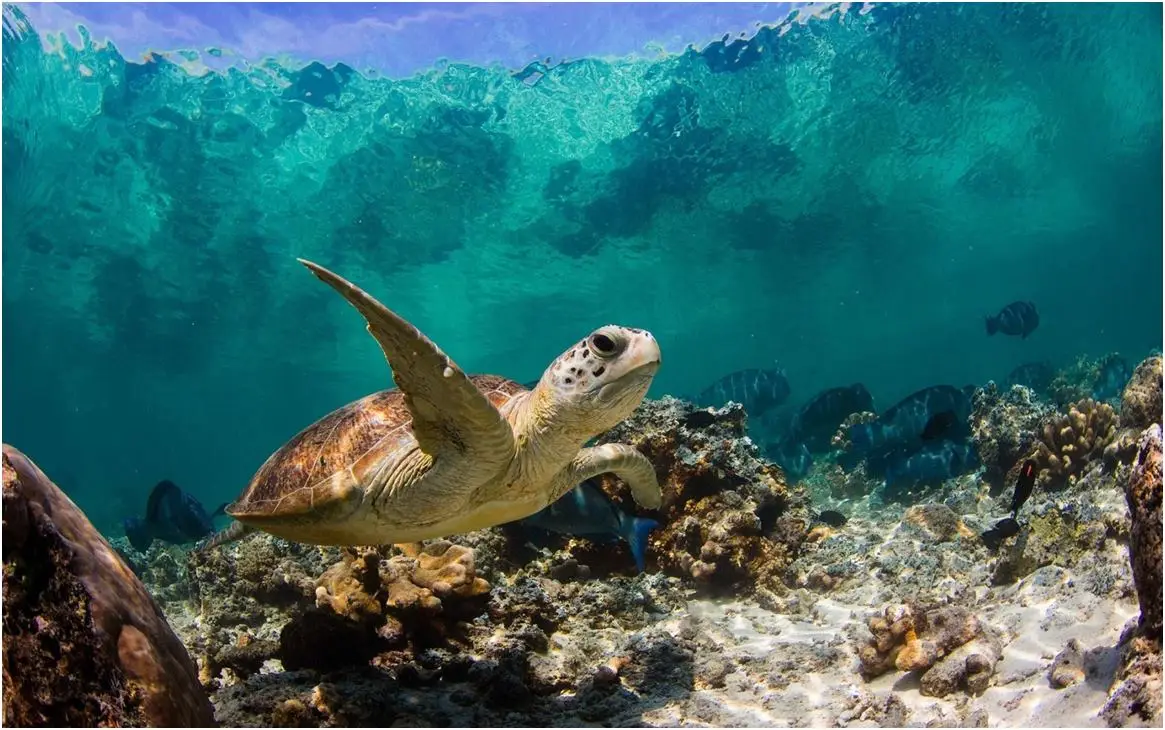
Snorkelling in Barbados
Turtles, Shipwrecks & Crystal Water
A guide to the marine life waiting beneath the surface.
Marine Life
One of the Caribbean's Great Snorkelling Destinations
Barbados sits at the eastern edge of the Caribbean, where warm Atlantic waters meet calm, sheltered coastline. The result is year-round snorkelling in water that rarely drops below 26°C — clear, warm, and teeming with life.
The coastline is home to a resident population of hawksbill and green sea turtles, six shipwrecks within swimming distance of shore in Carlisle Bay, and coral reefs alive with tropical fish, sea fans, and barrel sponges. It is one of the few places in the Caribbean where you can reliably swim alongside critically endangered hawksbill turtles in their natural habitat, any month of the year.
This guide covers what you'll find beneath the surface, when to visit, and how to explore it all responsibly.
Our Turtles
Hawksbill & Green Sea Turtles
Critically Endangered
Hawksbill Turtle
Barbados hosts the largest hawksbill nesting population in the insular Caribbean. These turtles are recognisable by their overlapping shell plates and narrow, pointed beak — evolved for feeding on sponges deep within coral crevices. By eating sponges that would otherwise overgrow the reef, hawksbills play an essential role in keeping coral ecosystems healthy.
Adults reach 2 to 3.5 feet in shell length, weighing up to 70 kg. They are resident on the coastal reefs and viewable year-round. The population has recovered from fewer than 100 nesting females in the 1990s to over 600 today.
Resident Population
Green Sea Turtle
Named not for their shell but for the colour of their fat — a result of their herbivorous diet — green sea turtles are the larger of the two species found in Barbados waters. They graze on seagrass beds, maintaining habitats that serve as nurseries for commercially important fish species and act as natural carbon sinks.
Commonly seen at popular snorkelling sites and resident year-round, adults typically reach 3 to 4 feet in shell length — in rare cases weighing up to 270 kg!
Both species are protected under Barbados law. Nesting season runs from June to November, with hatchlings emerging from August onwards.
Wrecks & Reefs
Shipwrecks & Coral Reefs
Barbados has been creating artificial reefs since the 1970s, deliberately sinking decommissioned vessels along the coastline to build new marine habitat. Combined with the natural reef systems, it makes for some of the most varied snorkelling in the Caribbean. Our cruises visit different sites depending on sea conditions.
Carlisle Bay
~6 metres · Since 1919
The Berwyn
A French tugboat from the First World War, and the shallowest wreck in Carlisle Bay. After over a century on the seabed, the Berwyn is completely encrusted with coral and sponge — more reef than ship now. Schooling fish weave through what remains of the hull. An ideal first wreck for snorkellers.
~11 metres · Since 2002
The Bajan Queen
At 120 feet, the largest wreck in Carlisle Bay. Originally Barbados's first tugboat, she was later converted into a floating party venue before being donated and intentionally sunk to create an artificial reef. Her deck, bridge, and hold are all visible — the upper sections reachable by confident snorkellers.
~5 metres · Shallow Access
The Cornwallis
A merchant vessel resting in just five metres of water, making it one of the most accessible wrecks for snorkellers. The shallow depth and clear water mean you can see the entire structure from the surface — a good starting point before exploring the deeper wrecks nearby.
The Coast
Holetown · Snorkel Depth
Folkestone Marine Park
A protected marine reserve near Holetown with shallow reef, seagrass beds, and several barges sunk deliberately to create artificial habitat. Coral formations, sea fans, and schools of tropical fish in calm, sheltered water — excellent for snorkelling.
Prospect · Since 1974
Lord Combermere
A 60-foot steel water carrier sunk off Prospect, St. James, in 1974 — one of the earliest artificial reefs in Barbados. She sits upright at around 15 metres, her holds sheltering dense schools of copper sweepers. A quieter site, less visited than the Carlisle Bay wrecks.
Speightstown · Since 1985
The Pamir
A 165-foot freighter deliberately scuttled off the northwest coast in the mid-1980s. She sits upright with a distinctive V-shaped bow, her hull open for exploration. Along with the Stavronikita — a 365-foot Greek freighter at Folkestone — these deeper sites are accessible to scuba divers.
Marine Life
Beyond the Turtles
The reefs and wrecks of Barbados are home to far more than turtles. On a typical snorkel stop you'll encounter parrotfish, blue tang, sergeant majors, and trumpetfish drifting among sea fans and brain coral. Reef squid hover in formation near the surface. Moray eels peer from crevices in the wreck structures. Stingrays glide across the sandy bottom between reef patches.
The coral itself is worth the visit — elkhorn and staghorn coral, barrel sponges, azure vase sponges, and soft sea whips that sway with the current. In calm conditions, visibility reaches 20 metres or more.
Seasons
When to Go
December – April
Dry Season
The calmest seas, clearest visibility, and sunniest days. Water temperature around 26–27°C. This is peak season for visitors, so book early.
June – November
Nesting & Hatching Season
Turtle nesting runs from June to November, with hatchlings emerging from August onwards. Warm water, fewer crowds, and excellent snorkelling conditions. A good time to visit if you want to combine snorkelling with a chance to see nesting activity on the beaches.
August – November
Late Summer
The warmest water of the year (28–29°C). Brief tropical showers are possible but rarely affect conditions underwater. Visibility can be slightly reduced after storms, but recovers quickly.
Year-Round
Turtles Are Always Here
Both hawksbill and green turtles are resident on the coastal reefs. Unlike some destinations where wildlife is seasonal, you can swim with turtles in Barbados in any month of the year.
Conservation
Protecting What Matters
Barbados's turtle population is a conservation success story. In the 1990s, fewer than 100 hawksbill turtles were recorded nesting on the island's beaches. Today, thanks to decades of dedicated work, that number has grown to over 600 nesting females — making Barbados home to the largest hawksbill nesting population in the insular Caribbean.
The Barbados Sea Turtle Project, founded in 1987 by Dr Julia Horrocks at the University of the West Indies, has been at the heart of this recovery. The project runs nightly beach patrols during nesting season, operates a turtle rescue and rehabilitation programme, and has helped rescue more than 100,000 hatchlings over its lifetime. In 1998, Barbados introduced a total moratorium on sea turtle harvesting — one of the strongest protections in the Caribbean.
Marine tourism and conservation are deeply connected here. Ninety-five per cent of tourism sites in Barbados are coastal, and the island's reefs generate over one million US dollars in tourism revenue per square kilometre each year. Protecting the marine environment isn't just the right thing to do — it's the foundation of the island's economy.
Respect the Reef
How to Snorkel Responsibly
Don't Touch the Turtles
Sea turtles are protected by law in Barbados. They don't need to be touched. Stay calm, float quietly, and let them come to you — the encounters are far more rewarding that way.
Never Stand on Coral
Even light contact can damage decades of growth. If you need to rest, find a sandy patch or hold onto the boat line. Be mindful of your fins — a careless kick can break what took years to form.
Use Reef-Safe Sunscreen
Choose mineral-based, reef-safe sunscreens free of oxybenzone and octinoxate, which can damage coral. A rash guard or UV-protective clothing is a great complement for extra coverage.
Give Turtles Space to Breathe
Sea turtles must surface regularly to breathe. Never block their path upwards, and avoid crowding around a single turtle. If several people are in the water, take turns and keep a respectful distance.
Follow Your Guide
Experienced crew know where to find the best marine life and how to approach it safely. They'll position you in the right spot, point out things you'd otherwise miss, and ensure both you and the wildlife are comfortable.
Report What You See
If you see a nesting turtle or hatchlings on the beach, please do not touch them. Call the Barbados Sea Turtle Project 24-hour hotline: +1 (246) 230-0142. They will guide you on what to do.
Sail With Us
See It for Yourself
Both of our cruises include two snorkel stops — one with the turtles, one at a shipwreck or reef — with all equipment provided and our crew in the water alongside you. Just about twelve guests per sailing.
Departs 9:00 AM · 5 Hours
The Lunch Cruise
Five hours of coastline sailing, turtle snorkelling, shipwreck or reef exploration, open bar, and a family-style Bajan lunch on deck.
Departs 2:45 PM · 4 Hours
The Afternoon Cruise
Four hours of turtle encounters, reef or shipwreck snorkelling, open bar, a Bajan dinner, and a Caribbean sunset to finish.
Common Questions
Frequently Asked
Get in Touch